
Invisalign for Kids, Teens & Adults
About Invisalign
Invisalign uses a series of clear, custom-made plastic aligners to move your teeth into position — no brackets, no wires, and nothing that shows up in photographs. It’s been around since the late 1990s and has treated millions of patients worldwide, so this isn’t experimental technology. It’s a well-established alternative to braces that happens to be nearly invisible while you wear it.
The treatment corrects most of what braces correct: crowding, spacing and gaps, overbite, underbite, crossbite, and crooked or rotated teeth. Each aligner in your series is engineered to move
The catch — and there is one — is that Invisalign only works when you wear it. Aligners need to be in your mouth 20 to 22 hours a day, which means taking them out for meals and brushing and putting them straight back in. Patients who treat them as optional don’t finish on schedule. Patients who commit to the routine tend to find it becomes automatic within a couple of weeks.
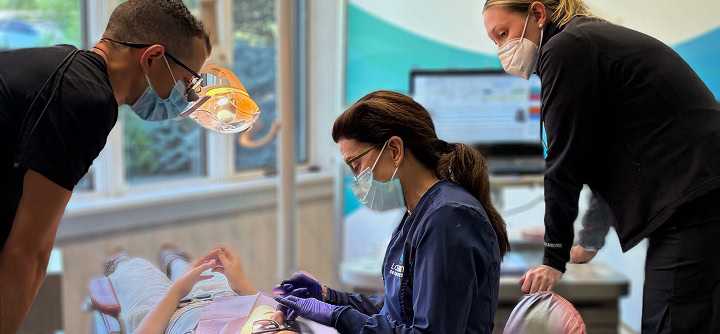
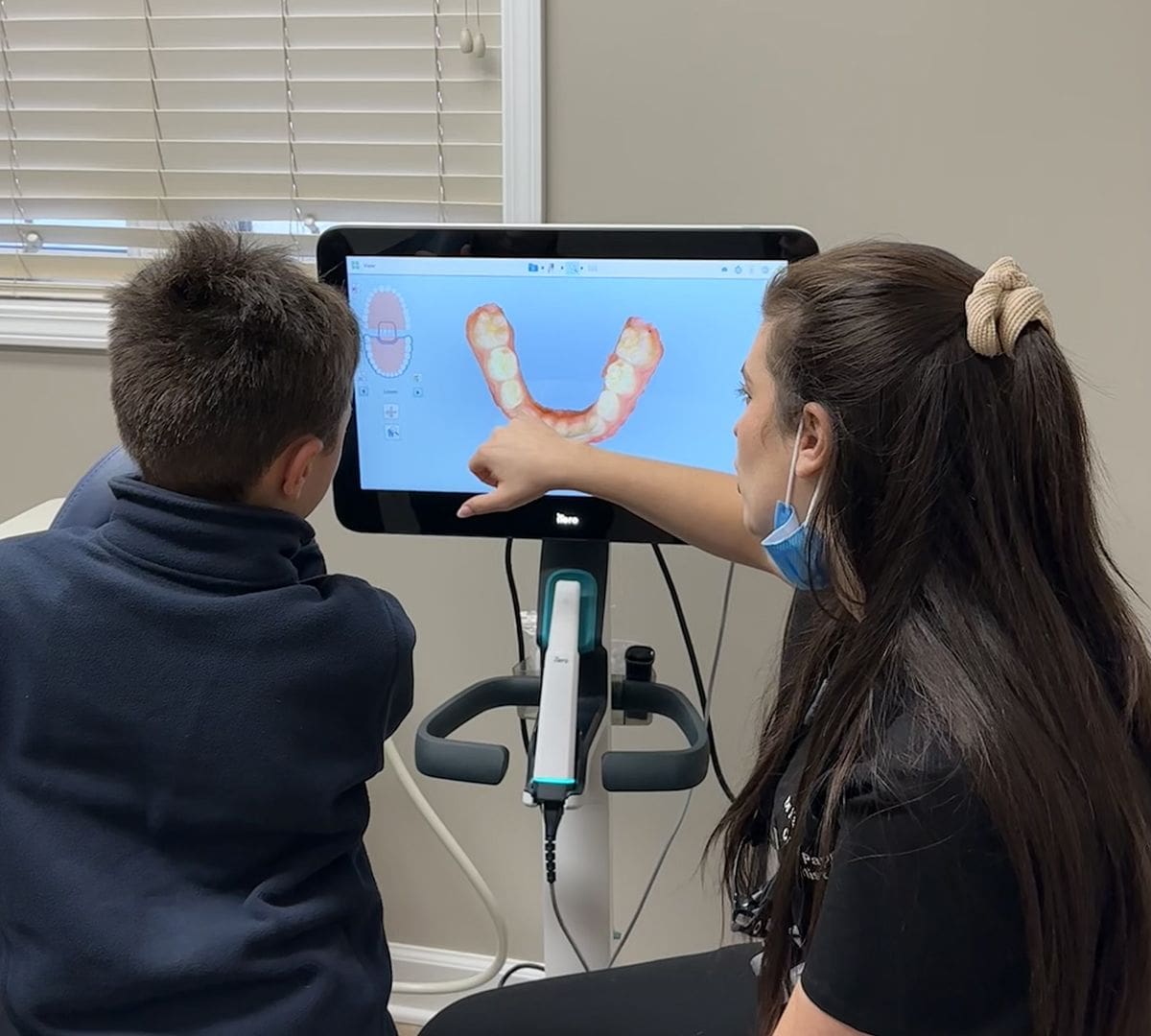
At Efros Orthodontics, treatment starts with a free consult. Our doctors examine your teeth and bite, take X-rays where needed, and use the iTero scanner to build a detailed 3D model of your mouth in a few minutes — no impression trays, no putty, no radiation from the scan itself. That model goes up on the screen beside you, so you can see the problem our doctors are describing and understand what treatment would involve before you decide anything. If braces turn out to be the better fit for your case, we’ll tell you that too.
Invisalign For Kids
Invisalign has a version built specifically for children: Invisalign First. It’s designed for kids who are still growing and may still have baby teeth, and it accommodates a mouth that’s actively changing shape — something standard aligners weren’t built to do.
Invisalign First is generally used as phase one treatment, roughly between ages 6 and 10. The goal at that stage isn’t a finished smile; it’s creating room and guiding development so that phase two, usually around ages 10 to 14, is shorter and simpler. It can address crowding, spacing, narrow dental arches, and developing bite problems. Before clear aligners existed, this work was done with expanders and early braces, which still remain good options — our doctors will recommend whichever suits your child’s case.
For a lot of families, the appeal is how little changes at home. Your child eats normally, since the aligners come out for meals. Brushing and flossing stay the same, with no brackets to navigate. Sports continue as usual, though a mouthguard is still a good idea for contact sports. There’s nothing to break, so there are no emergency visits for a snapped wire after a bag of popcorn.
The trade-off is responsibility. Aligners only work when they’re in, and a 7-year-old needs a parent tracking wear time and aligner changes. Some kids handle it easily; others do better with braces they can’t take out. That’s an honest conversation to have with our doctors at your child’s free consult, and the American Association of Orthodontists recommends a first orthodontic check by age 7 regardless of which route you end up taking.


Invisalign For Teens
Invisalign is a popular choice among teens for a reason that’s easy to understand: for two years of high school, most teenagers would rather not have metal on their teeth. The aligners are close to unnoticeable in conversation and in photos, and they don’t come with the food restrictions that make school lunches and pizza nights complicated.
The practical case is just as strong. Aligners come out for meals, so nothing is off-limits. Brushing and flossing stay normal, which matters a great deal for a group not famous for meticulous oral hygiene — braces trap plaque around brackets, and that can leave white marks on newly straightened teeth. There’s no wire to poke, no bracket to pop off before a game, and no wax needed. Visits are short and spaced about six weeks apart, which is easier to fit around practices, rehearsals, and jobs.
Compliance is the whole ballgame. Twenty to 22 hours a day is a real commitment, and a teen who leaves their aligners in a locker isn’t making progress. Invisalign aligners for teens include small blue indicators that fade with wear, so parents and our doctors can see at a glance whether they’re actually being worn. Some teens rise to that responsibility and some don’t, and it’s worth being realistic about which yours is — braces work regardless of motivation, which is sometimes the deciding factor.
Cost shouldn’t drive the decision. At Efros Orthodontics, Invisalign and braces are priced the same, because we want patients choosing the treatment that fits their life rather than their budget. Treatment length is comparable too, typically somewhere in the 12-to-18-month range for many teen cases and longer for complex ones. Our doctors will lay out both options at your teen’s free consult and give you a straight recommendation.
Invisalign For Adults
Adults make up a large and growing share of orthodontic patients, and Invisalign is a big part of why. Straightening your teeth in your thirties, forties, or sixties no longer means announcing it to every client, colleague, and stranger you talk to. The aligners are clear, thin enough not to affect your speech, and removable for the moments when you’d rather not have them in at all.
The reasons adults come in vary. Teeth that shifted years after childhood braces, because a retainer got abandoned somewhere along the way. Crowding that has slowly worsened. A bite problem that was never addressed. Or simply not liking how your smile looks in photographs. Any of those is a legitimate reason, and correcting a misaligned bite isn’t purely cosmetic — it can ease jaw soreness, uneven tooth wear, and difficulty chewing.


Day to day, Invisalign fits around adult life with minimal friction. Aligners come out for meals and go back in after you brush, so there are no food restrictions and your normal hygiene routine is unchanged. Coffee drinkers should take them out first, since hot liquids can warp the plastic and coffee will stain it. The same goes for smoking. Rinse your aligners when you take them out, brush them gently with a soft toothbrush and lukewarm water daily, and keep them in their case rather than a napkin. Many adults finish treatment with Zoom whitening, which is a satisfying way to cap it off.
On cost, an accurate figure requires an exam, but the structure is straightforward: Invisalign is priced the same as braces here, consults are free with no obligation, we’re in-network with most major insurance plans, and we offer 0% interest payment plans that can extend up to three years with monthly payments as low as $99 in some cases. Discounts are available for siblings, military personnel, teachers, and first responders. Our payment calculator will give you a rough estimate in a couple of minutes.
Invisalign FAQ
Many patients finish in 12 to 18 months, though complex cases take longer and minor corrections can go faster. Treatment length depends on what’s being corrected and, more than anything, on how consistently you wear your aligners. Invisalign and braces take a comparable amount of time overall, so choosing aligners isn’t a shortcut. Our doctors will give you an estimated range at your free consult.
Twenty to 22 hours. In practice that means wearing them all day and all night, taking them out only to eat, drink anything other than water, and brush. Falling short slows your progress and can mean an aligner no longer fits properly, which sets you back further. Put them back in as soon as you’re done eating and the routine stops requiring thought fairly quickly.
Yes, and this is one of the main advantages over braces — nothing is off the menu, because the aligners come out first. Two rules: only water goes in your mouth while the aligners are in, and brush before you put them back. Coffee, tea, and red wine will stain the plastic, and hot drinks can warp it. Don’t chew gum while wearing them.
Rinse them whenever you take them out, and brush them gently once a day with a soft toothbrush and lukewarm water. Skip hot water, which warps the plastic, and abrasive toothpaste, which scratches it and leaves aligners looking cloudy. Because the aligners sit against your teeth most of the day, anything left on your teeth stays there too, so brushing before you put them back in matters for your teeth as much as the aligners.
Don’t panic — it happens to plenty of patients, and it’s fixable. Call us, and in the meantime go back to your previous aligner rather than leaving your teeth unsupported. If you were within a few days of switching anyway, our doctors may have you move ahead to the next set instead. Either way, get in touch so we can order a replacement and keep your treatment on track.
Yes. Orthodontists and dentists do different jobs: our doctors move your teeth and correct your bite, while your dentist keeps your teeth and gums healthy. Keep up your regular cleanings and checkups throughout treatment. Aligners are easier to clean around than braces, but they also sit against your teeth for 20-plus hours a day, which makes routine dental care more important, not less.
It depends on your case, which is why the exam that answers the question is free and carries no obligation. Two things worth knowing up front: we price Invisalign and braces the same, so cost shouldn’t push you toward one over the other, and we’re in-network with most major insurance plans. We also offer 0% interest payment plans extendable up to three years, with payments as low as $99 a month in some cases, plus discounts for siblings, military personnel, teachers, and first responders. Try our payment calculator or ask a treatment coordinator to walk through the numbers with you.