
Braces for Kids, Teens & Adults
Types Of Braces
Braces have been around for generations, and they’re still the workhorse of orthodontics because they work — reliably, on a wide range of problems, for patients of every age. What has changed is the hardware. Brackets are smaller, wires are lighter, and treatment is more comfortable than what your parents or grandparents went through.
At Efros Orthodontics, we offer two kinds of braces: traditional metal and clear ceramic. Both work the same way, using steady, gentle pressure to guide teeth into better positions over time.
The difference is how visible they are and, for some patients, how they hold up day to day. Our doctors will talk through both options at your free consult and recommend the one that fits your case and your life.
Braces do more than straighten crooked teeth. They correct bite misalignment, crowding, and spacing — problems that can make chewing, speaking, and even breathing uncomfortable, and that tend to get more expensive to fix the longer they’re left alone. They’re also not removable, which sounds like a drawback until you consider that there’s nothing to lose, forget, or leave in a restaurant napkin. A couple of weeks in, most patients stop thinking about them entirely.
If you’re weighing braces against clear aligners, our Invisalign page covers that side of the decision. Either way, the visit that answers the question is free.
Traditional braces use stainless steel brackets bonded to the front of each tooth with a non-toxic adhesive, connected by a thin archwire and held in place with small elastics. You’ll come in every four to six weeks so our doctors can adjust the wire and keep your teeth moving on schedule. Metal braces are the most durable option and handle the most complex cases, which is why they’re still the most common choice for kids and teens. They also come with colored elastics, which most younger patients treat as the best part.
Clear braces work exactly like metal ones, but the brackets are made from a ceramic material tinted to blend with your natural tooth color. Several shades are available, so we can match yours closely. From a conversational distance, they’re genuinely hard to notice — which is why adults and image-conscious teens tend to gravitate toward them. The trade-off is that ceramic brackets are slightly larger and a bit more delicate than metal, so they need a little more care. Adjustment visits follow the same four-to-six-week rhythm.
Braces For Kids
Most people picture teenagers when they think about braces, but children are a big part of what we do. The American Association of Orthodontists recommends a first orthodontic check by age 7 — not because most 7-year-olds need braces, but because that’s when our doctors can see how the jaw is developing and whether permanent teeth have room to come in straight. Catching a problem while the jaw is still growing often means simpler, shorter treatment than waiting until the teeth and bones have set.
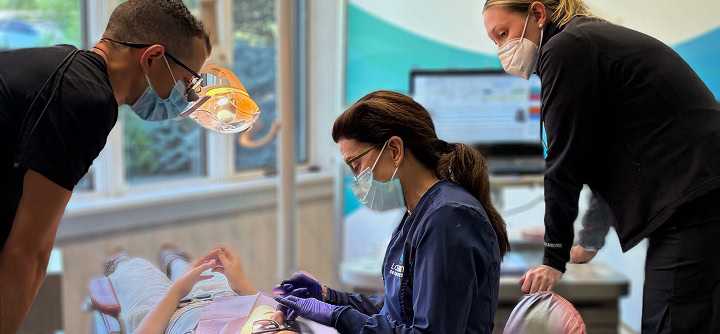
At a first visit, our doctors examine your child’s mouth and take digital scans and X-rays to see what’s happening beneath the surface — how the jaws are positioned, which teeth are still to come, and the direction they’re heading. You’ll hear plainly whether treatment is needed now, later, or not at all. If your child isn’t ready yet, we’ll simply keep an eye on things with periodic check-ins at no cost to you.
Braces do more than straighten crooked teeth. They correct bite misalignment, crowding, and spacing — problems that can make chewing, speaking, and even breathing uncomfortable, and that tend to get more expensive to fix the longer they’re left alone. They’re also not removable, which sounds like a drawback until you consider that there’s nothing to lose, forget, or leave in a restaurant napkin. A couple of weeks in, most patients stop thinking about them entirely.
If you’re weighing braces against clear aligners, our Invisalign page covers that side of the decision. Either way, the visit that answers the question is free.


Braces For Teens
The teen years are the sweet spot for orthodontics. Permanent teeth are in, the jaw is still growing enough to cooperate, and treatment tends to move efficiently. Most teens finish in somewhere between 12 and 30 months, depending on what’s being corrected, how quickly their teeth respond, and — honestly — how well they follow instructions.
Both metal and clear braces are on the table. Metal is tougher and better suited to contact sports and complex corrections; clear ceramic is far less noticeable, which matters more to some teens than others. It’s worth letting your teen weigh in on the choice, since a patient who likes their braces takes better care of them.
Life with braces asks for a few adjustments. Skip hard, sticky, and chewy foods, cut apples and corn off the cob instead of biting in, and use a braces-friendly mouthguard for any contact sport. Brushing and flossing matter more than usual, because brackets and wires trap plaque, and plaque left alone leads to cavities and white marks on newly straightened teeth. If a wire pokes or a bracket loosens, call us — dental wax will get your teen through the day, and we’ll get them in.
The best way to find out whether braces are the right call is a free consult. Our doctors use the iTero scanner to build a detailed 3D model of your teen’s teeth and bite in a few minutes, with no radiation and none of the putty-filled impression trays everyone remembers hating. The scan goes up on the screen so you can see exactly what our doctors are describing, and a treatment coordinator will walk you through timing and cost before you commit to anything.
Braces For Adults
There’s no upper age limit on straightening your teeth. Adults now make up a significant share of orthodontic patients, and the reasons vary: teeth that shifted after childhood braces, a bite problem that was never addressed, crowding that has gotten worse over time, or simply wanting to like your smile in photographs.


Braces are just as effective in adulthood, though treatment sometimes takes a little longer, since adult bone doesn’t remodel as quickly as a teenager’s. They correct the same range of issues — crooked teeth, crowding, spacing, overbite, underbite, crossbite — and correcting them isn’t only cosmetic. Misaligned bites can contribute to jaw pain, uneven tooth wear, headaches, and difficulty chewing. If you’ve dealt with chronic jaw soreness or clicking, that’s worth mentioning at your consult.
Most adults who choose braces over aligners go with clear ceramic brackets. They blend in well enough that they don’t dominate a conversation or a video call, and they handle cases that aligners can’t. Our doctors will tell you honestly whether your case is better suited to braces or Invisalign rather than steering you toward one by default. Many adults also add Zoom whitening once their braces come off, which is a satisfying way to finish.
Life with braces asks for a few adjustments. Skip hard, sticky, and chewy foods, cut apples and corn off the cob instead of biting in, and use a braces-friendly mouthguard for any contact sport. Brushing and flossing matter more than usual, because brackets and wires trap plaque, and plaque left alone leads to cavities and white marks on newly straightened teeth. If a wire pokes or a bracket loosens, call us — dental wax will get your teen through the day, and we’ll get them in.
The best way to find out whether braces are the right call is a free consult. Our doctors use the iTero scanner to build a detailed 3D model of your teen’s teeth and bite in a few minutes, with no radiation and none of the putty-filled impression trays everyone remembers hating. The scan goes up on the screen so you can see exactly what our doctors are describing, and a treatment coordinator will walk you through timing and cost before you commit to anything.
Braces FAQ
Most patients are in braces somewhere between 12 and 30 months. The exact timeline depends on what’s being corrected, how quickly your teeth respond, and how consistently you follow your treatment plan — wearing elastics as directed makes a real difference. Our doctors will give you an estimated range at your free consult and keep you updated as you go.
Braces aren’t painful, but they can be uncomfortable at points. Expect some tenderness for a day or two after they go on and after each adjustment, when your teeth are under fresh pressure. Soft foods and an over-the-counter pain reliever cover it. If a bracket is rubbing the inside of your lip or cheek, the dental wax we send home with you smooths the surface until your mouth adjusts, which usually takes about a week.
Every four to six weeks. These visits are short — our doctors adjust or change your archwire, swap elastics, and check that everything is tracking as planned. Keeping these appointments is one of the biggest factors in finishing on schedule. With nine locations, you can usually find a time and a place that works around school or your workday.
Anything hard, sticky, or chewy is the short answer: ice, hard candy, caramel, taffy, gum, nuts, popcorn, and hard crusty bread. Crunchy things you’d normally bite into — apples, carrots, corn on the cob — are fine if you cut them up first. These aren’t arbitrary rules; broken brackets and bent wires mean an extra trip in and can add time to your treatment.
Give us a call. Most of these aren’t emergencies, but they do need attention so treatment stays on track. In the meantime, dental wax over the spot will keep it from rubbing, and if a wire has shifted, a clean pencil eraser can gently nudge it back into place. Don’t cut a wire yourself. We’ll get you in as soon as we can.
Yes, and it’s more important than usual. Orthodontists and dentists do different jobs: our doctors move your teeth and align your bite, while your dentist keeps your teeth and gums healthy. Brackets and wires give plaque more places to hide, so stick with your regular cleanings and checkups throughout treatment. Straight teeth aren’t much of a win if they arrive with cavities.
It depends on your case, so an exam is the only way to get an accurate number — which is exactly why our consults are free and carry no obligation. Once you know what treatment involves, we’ll walk through the options: we’re in-network with most major insurance plans, offer 0% interest payment plans extendable up to three years with payments as low as $99 a month in some cases, and provide discounts for siblings, military personnel, teachers, and first responders. Try our payment calculator for a quick estimate, or ask a treatment coordinator to walk you through it.